
A hunter archive organized around real run decisions
We are publishing the Pass the Fear Wiki as a complete player reference for the supernatural co-op game’s items, characters, mechanics, progression, and builds. The design begins with questions players ask during or between runs rather than with the shape of the extracted data. What does this relic really do? How does one weapon family differ from another? Which status is a tooltip referring to? Can these parts, relics, Tarot faces, and upgrades form a legal two-weapon loadout? Those questions become direct paths through the site.
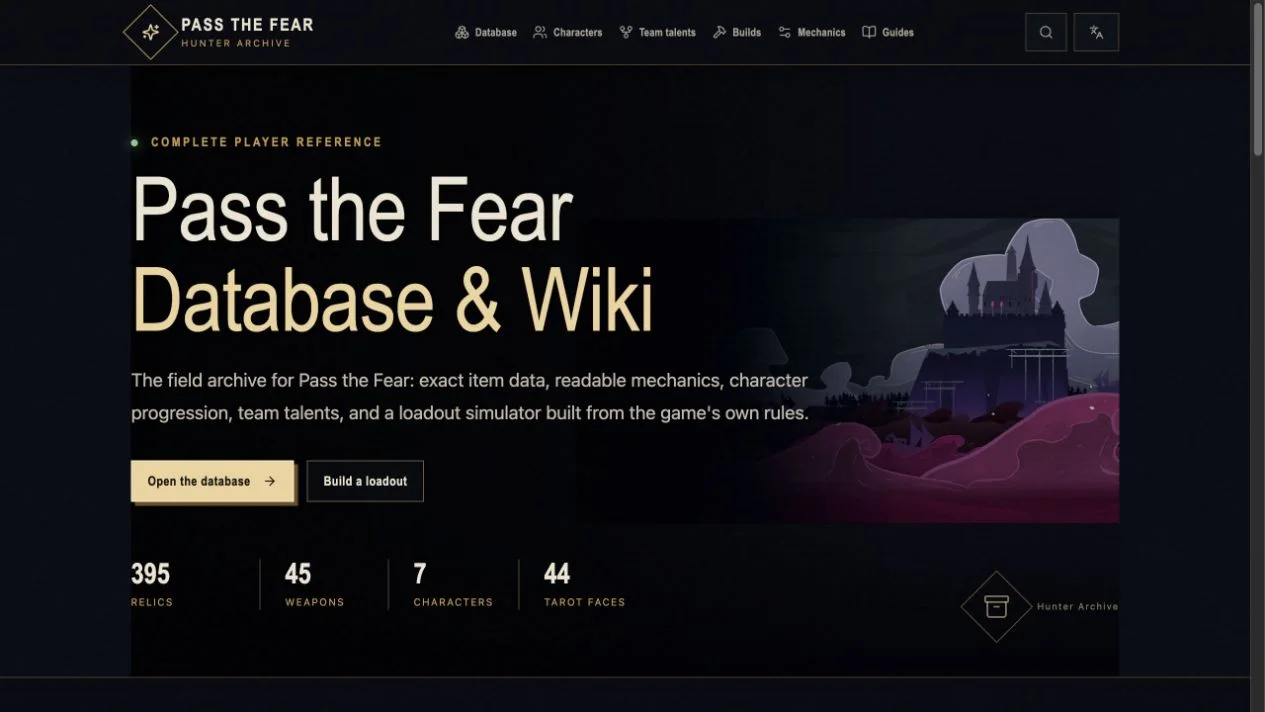
The home page summarizes the current archive with 395 relics, 45 weapon families, seven characters, and 44 Tarot faces. It then offers four starting tasks: identify a relic, compare weapons, decode a mechanic, or plan a run. That structure prevents the wiki from becoming another index that sends readers through several lists before revealing the relevant rule. Database records remain available for detailed research, but featured paths connect the fields that matter when a player is deciding what to pick, forge, dismantle, equip, or upgrade.
Relic search includes the rules that cards do not always surface
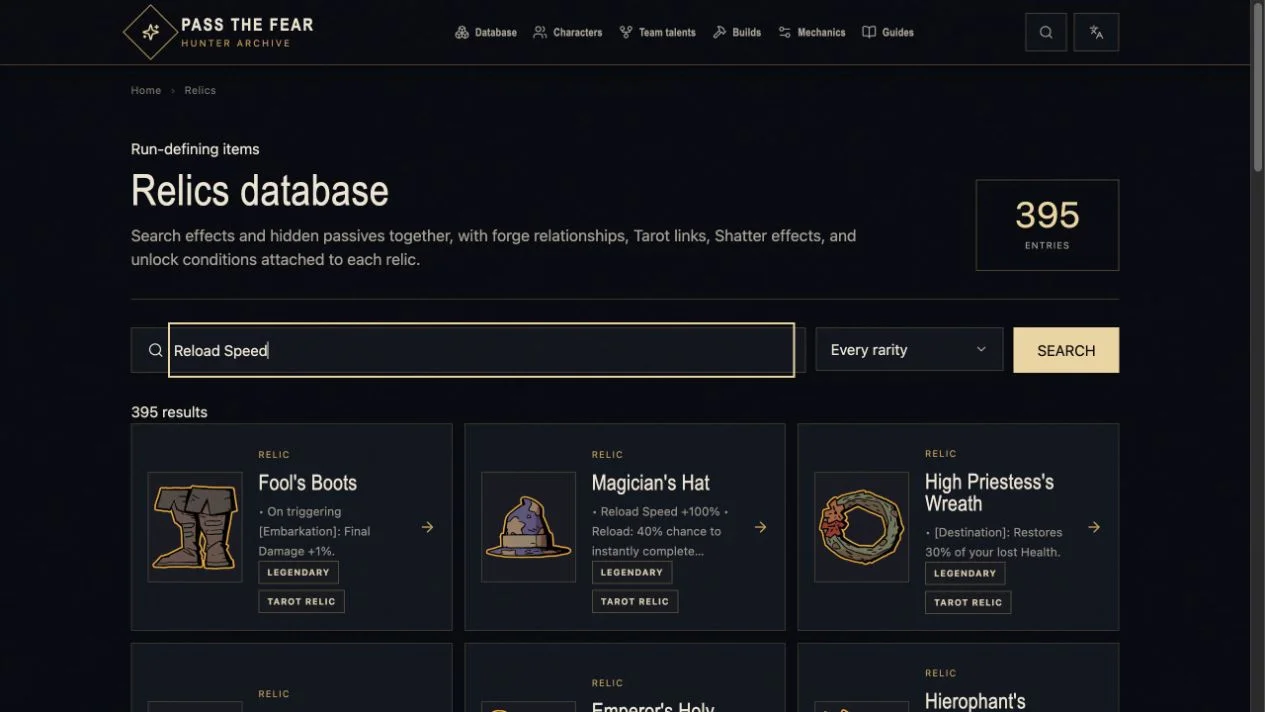
The Relics Database searches names, printed effects, triggers, hidden passives, unlock conditions, forge links, Shatter results, and Tarot relationships. Rarity can be filtered without turning rarity into a recommendation. A lower-rarity item that completes a reliable trigger chain may matter more than an isolated legendary effect, so each result exposes the wording needed to compare behavior. Detail pages separate the relic currently owned from a forged destination and show the relevant relationship rather than implying that both records share the same effect.
Shatter is treated as a mechanic, not merely a dismantle label. Before clearing inventory, a player can inspect the effect triggered when an item is dismantled and search for other records that repeat, redirect, or reward the same event. Tarot relics connect an Arcana to a base relic and forged counterpart. Unlock requirements remain requirements rather than tactical advice, and hidden passives stay distinct from the visible card. This complete record helps explain why a search can find an item through text that is not obvious in its short reward summary.
Weapon families expose rolls, timing, and effects
The weapon catalog groups 45 families and their rarity-specific records so players can compare element, damage range, magazine size, fire interval, special effects, and other current fields. A family name alone is not enough when a higher-rarity version changes an effect or roll, and a single attack number cannot explain cadence or elemental behavior. The archive therefore keeps family context and exact variants connected. Parts and affixes can be researched as part of a weapon choice rather than attached later as an afterthought.
This organization also supports build planning. A weapon selected in the simulator is not a generic label; it is a rarity-specific record with the associated range and legal part choices. The final sheet can preserve a minimum-to-maximum result when the game stores a roll rather than collapsing it to an invented average. Magazine, shot interval, critical properties, and weapon effects remain visible beside the calculated values. Runtime triggers are not automatically treated as permanent bonuses, which prevents a conditional weapon payoff from inflating every displayed total.
Readable mechanic pages decode shared vocabulary
The Mechanics section defines eighteen terms that item and skill tooltips assume the reader already understands. Transmutation outcomes such as Hemorrhage, Freeze, Disruption, Corrosion, and Ignition receive focused explanations, along with systems such as Shatter. These pages connect exact definitions to the relics, weapons, Tarot relationships, or guides that use them. A player can move from an unfamiliar keyword in a reward to the mechanic, then back to other records that trigger or benefit from the same state.
Mechanic references are written to separate verified outcomes from tactical interpretation. The page can document what a status does, how a printed trigger is expressed, and which records contain the relationship. Whether a specific co-op team can maintain that status reliably still depends on the selected weapons, characters, difficulty, and execution. Keeping those layers distinct makes guides clearer: a recommendation can explain when an effect tends to pay off without rewriting the mechanic as if every run had the same targets and timing.
The Build Planner models the whole legal inventory
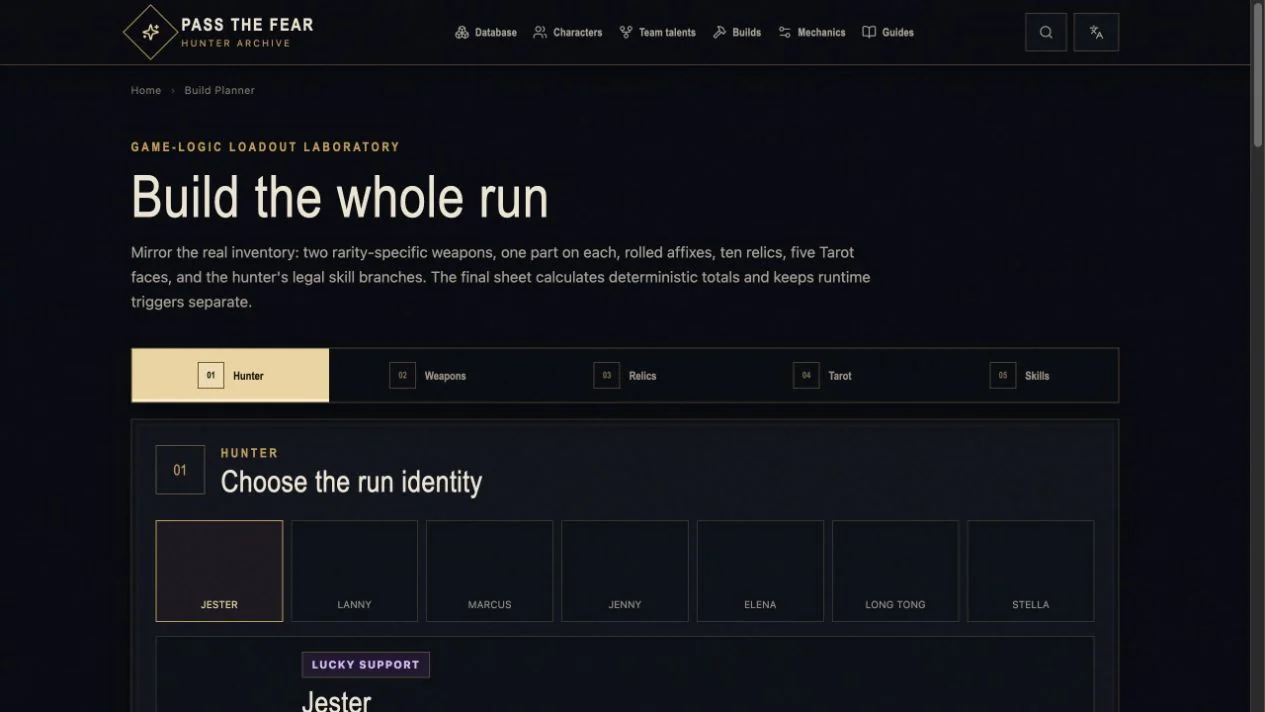
The Build Planner mirrors the complete run inventory: a hunter and level, two rarity-specific weapons, one part on each weapon, eligible affixes, ten relic slots, five Tarot slots, and the hunter’s legal personal upgrades. A five-step interface keeps Hunter, Weapons, Relics, Tarot, and Skills understandable while a calculated sheet remains available for the combined result. The tool rejects known rule conflicts and labels the current configuration as legal only when the modeled slot rules are satisfied.
The deterministic sheet includes global always-on attributes and weapon-local results. Health, movement, critical properties, reload speed, fire rate, Bullet Attack, Battle Skill Damage, Transmutation Damage, Final Damage, and elemental channels can be inspected alongside each weapon’s attack range, burst result, magazine, shot interval, and printed effects. The planner preserves range rolls and applies only recognized unconditional modifiers to the always-on arithmetic. Conditions such as a character state, ultimate trigger, destination event, or temporary buff stay in a separate runtime ledger with their printed requirement.
Seven character panels connect identity to progression
Character pages cover Jester, Lanny, Marcus, Jenny, Elena, Long Tong, and Stella. Each panel explains the character’s practical identity, basic skills, and upgrade layers rather than reducing the choice to one ranking. Jester turns luck, healing, and team momentum into support; Lanny converts coins and treasure into scaling; Marcus emphasizes disciplined gunplay; Jenny spreads weapon elements through bombs; Elena amplifies anomaly play; Long Tong fights with Amber; and Stella builds around Starlight and Tarot outcomes.
The planner can apply the selected character level and legal personal upgrades while keeping their runtime requirements intact. That matters when an upgrade increases a stat only during Novice’s Luck, Justice Heart, or another named state. Adding the percentage permanently would make the displayed sheet look impressive but wrong. Instead, the condition remains visible beside the possible change. Players can compare a baseline configuration, select the upgrades they can actually reach, and understand which part of the result will appear only after a trigger in the run.
Tarot, team talents, difficulty, and co-op guides complete the run context
Tarot pages connect 44 faces to upright or reversed outcomes and their associated relic relationships. Team talent references help a co-op group understand shared progression choices, while difficulty pages compare the six Journey to Reality tiers, Battle Scar rules, future-chapter enemies, and treasure-quality boons. These systems are linked from builds because a loadout is always carried into a difficulty and team context. A legal sheet is the start of the discussion, not a claim that the same choices are best for every tier.
Guides turn the reference into a sequence of actions. The transmutation guide explains when each verified elemental outcome can pay off and how buildup, direct triggers, and co-op roles change the decision. The co-op guide covers four-player lobby setup for Steam and LAN and organizes troubleshooting around online status, download region, VPN use, version agreement, and room recreation. Because guide steps link back to exact mechanics or current records, readers can distinguish a broadly useful procedure from a value that should be rechecked after an update.
How to use the archive on the next run
A practical route starts with the question that blocked the previous run. Search the Relics Database when a reward contains an unfamiliar trigger or a dismantle decision needs its Shatter effect. Compare weapon families when cadence, element, magazine, or a rarity-specific effect matters. Open Mechanics when the tooltip vocabulary is unclear. Use a character panel when planning progression, then assemble the complete inventory in the Build Planner. Keep the conditional ledger open while discussing the build so temporary bonuses are not mistaken for persistent stats.
The Pass the Fear Wiki is live at passthefear.wiki. It is an independent player archive intended to make exact game records readable and useful without hiding uncertainty behind a confident build label. The site will continue to review content as data and strategies evolve. At launch, the promise is already concrete: searchable relic rules, comparable weapon variants, connected character progression, mechanic definitions, and a simulator that models the slots and conditions of a real run. Enter the next lobby with a build you can explain, not only a list of rare names.